
Written by: Julian Frost, LEED AP O+M, Assistant Project Manager
Between June 11-14th, I attended the 33rd Congress for the New Urbanism in Providence, Rhode Island. With Lorax supporting my attendance, I was presented with an opportunity to step back from the everyday work of green building consulting and take a more universal view of sustainability in our built environment.
The Congress for the New Urbanism is an organization that brings together professionals from different built environment-related fields — urban design, architecture, engineering, planning, etc. — to advocate for human-scaled, walkable places. New Urbanism came about in the 1990s as the first coherently articulated intellectual and practical response to the damage done by modernist suburban sprawl development. CNU retains a focus on traditional urban design and architectural principles, but remains open to diverse perspectives.
Since the formal foundation of the movement, New Urbanist practitioners have designed countless town centers and master plans across the world, and have been leaders in sustainability and green building, the development of form-based codes as an alternative to use-segregated zoning, climate resilience and planning for climate migration, and policy changes to allow more incremental, small-scale development. Sustainability, of course, doesn’t stop at the building scale. Subtle differences in development patterns, urban design, and codes can have massive effects on vehicle miles traveled and energy demand.
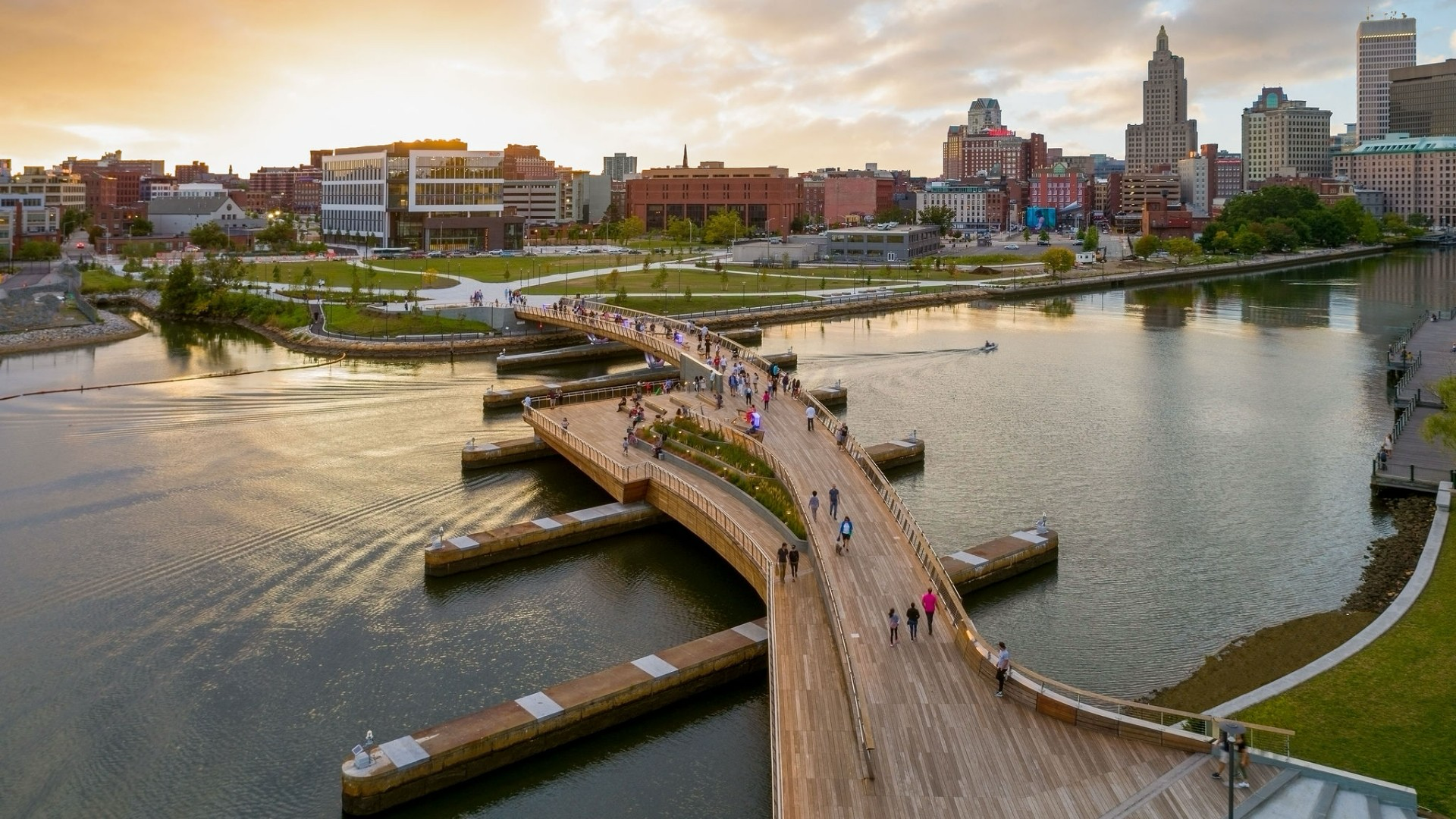
195 District Park in Providence, RI
Part of my reason for attending was my participation in a session titled “Single-Stair Reform: Lessons from the I-95 Corridor”. Single-stair reform is an increasingly popular building code reform proposal to legalize European-style buildings with a single stair and elevator core up to 6 stories — an increase from the long-time American limit of 3 stories. The session was a collaboration between the CNU Mid-Atlantic Chapter (with whom I organized a single-stair design competition in Baltimore City) and the Boston-based architecture firm Utile, which produced a report on single-stair reform’s potential to improve housing choice and supply in Massachusetts.
The synergies between green building and New Urbanism are clear. Minimizing the impact of our presence on earth can be achieved through making our buildings minimally carbon intensive and making our settlements dense and conducive to walkability and a high quality of life for residents. Doing one of these things but neglecting the other is a terrible missed opportunity. Ideally, public policy would incentivize both at the same time.
New Urbanists like to emphasize that CNU is not a conference but a “congress” — a meeting of representatives from diverse geographies and professional backgrounds, all coming together with something to offer and something to learn. Here are some key thoughts I came away with.
Demographics and housing supply
80% of American households are not traditional nuclear families, but 72% of American housing units cater to traditional nuclear families. This means we have a shortage of the kind of smaller units that our population needs. It’s not just about supply and demand; a lack of the right kind of supply for a growing demand results in rising costs. We have countless Single Family Home (SFH) lots, but one house per standard lot will not get us where we need to be. To address this, a growing number of jurisdictions have been reforming zoning to allow solutions like cottage courts and Accessory Dwelling Units (ADUs) on single-family lots, and decreasing or eliminating minimum lot size rules.
Climate Migration
The US is split between places that are more exposed to the effects of climate change, and places that are well positioned to receive people. A non-profit called PLACE Initiative has been working on how to get towns in the former category to brand themselves as “receiver towns” and do the necessary work and promotion to accept climate refugees as an economic development strategy. Facilitating climate migration for the mutual benefit of “refugees” and “receiver” is something that could use a larger federal policy framework similar to the Infrastructure Investment and Jobs Act (IIJA).
Building consensus through art
Art holds a great importance in New Urbanism. Practitioners pride themselves on being able to express their ideas through sophisticated representations of their urban plans. I learned that outstanding watercolor artists are in high demand for top architecture firms. A room dedicated to the artistic output of New Urbanists drew attention to the fact that compelling visualizations of urban plans are an invaluable tool for convincing skeptical people that change might not be so bad after all.
“Missing Middle” Housing
This term, coined by Daniel Parolek of Opticos Design, points to the fact that it’s very easy to build a single-family home, and relatively easy to build a huge apartment building — but it’s become practically impossible to build the kinds of modestly-sized apartment buildings that have historically comprised much of America’s urban housing stock through the mid-20th century. There are many reasons for this including prohibitive zoning and some onerous building code restrictions that are presently undergoing scrutiny for the first time ever. As this knot of policy issues that makes “missing middle” so hard to build is gradually untied, opportunities for the development of modestly-sized apartment buildings in urban areas will increase.
Fiscal sustainability
Deindustrialization and other factors have hollowed out a lot of our cities while suburbs and exurbs have swelled in size. One of the strongest arguments for urbanism — that is, prioritizing denser urban infill development and turning away from greenfield development on the fringes — is that a spread-out single-family development pattern simply doesn’t generate the tax revenue to pay for all of its utilities, and creates a difficult situation for municipalities over time. Tweaking public policy to align incentives in the direction of gently densifying is the best path to fiscal sustainability. It may seem that we’ve already collectively chosen this path, but we have so much more work to do — think about how hard it is to try to build an infill building in Baltimore City.
I came away from the Congress for the New Urbanism with a renewed clarity on the structural issues that are holding us back from more sustainable development patterns. We have most of the answers already and have had them for a long time; it’s just a matter of gathering the strength and focus to implement them. Green building and making sustainable choices at the building level remains the best way for individual developers and building owners to make a positive impact on the environment and on the future financial health of their investment.